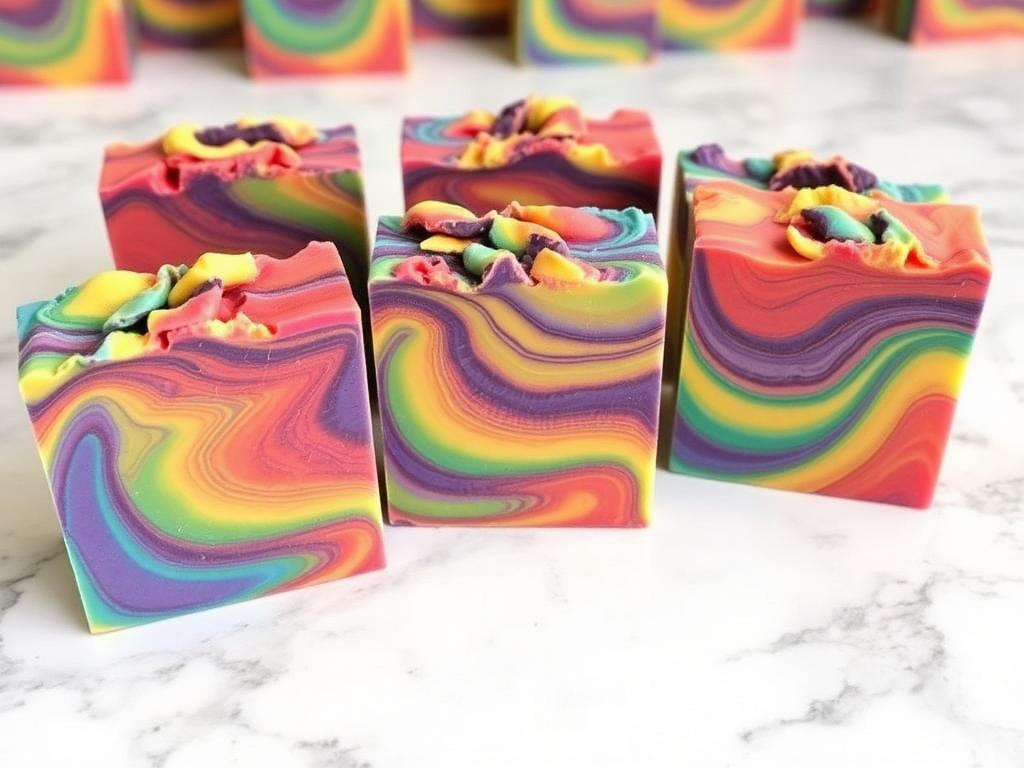
Some soaps are meant to be used. Others are meant to be admired first, then reluctantly used when guests finally stop commenting on how pretty they are. Rainbow swirl soap falls firmly into the second category. These bars command attention, drawing eyes and sparking conversations about how on earth you created something so vibrant.
The technique evolved from my experiments with layered soap. I'd mastered basic two-color designs and wanted something more dramatic. What if I poured multiple colors into the same mold at once? What if I dragged a skewer through them? The first attempts were muddy disasters—too many colors mixing into brown sludge. But persistence paid off, and eventually I learned the secrets to keeping colors distinct while creating fluid, organic patterns.
Temperature control makes or breaks rainbow soap. Each color needs to be at roughly the same temperature when you combine them, or the hotter ones will melt through the cooler ones, destroying your careful design. I keep a candy thermometer handy and aim for 130-135°F for all colors before pouring. This narrow window gives you the best chance of success.
The swirling technique itself rewards a light touch. Many beginners plunge their skewer deep and swirl vigorously, hoping for dramatic effects. In practice, gentle is better. One or two slow drags through the soap creates elegant curves. Over-swirling produces a muddled mess where individual colors lose their identity.
Color selection matters more than you might expect. Complementary colors on the color wheel—like orange and blue—can turn murky where they meet. Analogous colors—those sitting next to each other on the wheel—blend more gracefully. For true rainbow effects, I pour colors in spectral order: red, orange, yellow, green, blue, purple. This natural progression creates the most visually pleasing results.
Safety Warnings
- Work quickly with multiple containers of hot soap
- Use heat-resistant gloves when handling multiple cups
- Keep workspace organized to avoid spills
- Use skin-safe colorants only
Tools Needed
- Multiple microwave-safe containers (6+)
- Large loaf mold
- Wooden skewer or chopstick
- Candy thermometer
- Mica colorants or soap dyes
- Disposable pipettes for color
Ingredients
Step-by-Step Instructions
Prepare Color Stations
Divide base into 6 equal portions. Melt each separately and add one color to each container.
Check Temperatures
Use thermometer to ensure all colors are between 130-135°F before pouring.
Pour Colors
Pour colors in rainbow order, alternating sides of the mold. Create random patterns rather than perfect layers.
Swirl Gently
Using a skewer, make 1-2 slow passes through the soap. Less is more.
Cool and Cut
Allow to cool completely (4-6 hours). Cut into bars to reveal the pattern.
🔧 Common Mistakes & Fixes
📦 Storage Tips
- Wrap in plastic to preserve bright colors
- Keep away from direct sunlight
- Display these beauties proudly!
🔗 References & Further Reading
Independent sources for the chemistry and safety information on this page. We are not affiliated with any of them.
- 1.Glycerol (CID 753)(opens in a new tab)
PubChem, National Library of Medicine
Properties of glycerin, the humectant that makes melt & pour bases sweat in humid air.
- 2.Saponification(opens in a new tab)
Wikipedia
The chemical reaction behind every bar of real soap, with reaction equations and history.
- 3.Sodium Hydroxide (CID 14798)(opens in a new tab)
PubChem, National Library of Medicine
Full chemical and hazard profile for lye, including GHS classification and handling data.
- 4.Sodium Hydroxide Poisoning(opens in a new tab)
MedlinePlus, National Institutes of Health
Symptoms and emergency first-aid steps for lye exposure. Worth reading before you open the bottle.
- 5.Personal Protective Equipment — Overview(opens in a new tab)
U.S. Occupational Safety and Health Administration
What eye, hand, and skin protection actually protects against, and how to choose it.
- 6.Poison Help(opens in a new tab)
U.S. Health Resources and Services Administration
Poison control hotline and online help. Keep this reachable while you work.
- 7.Handcrafted Soap and Cosmetic Guild(opens in a new tab)
HSCG
Industry association for handcrafted soap makers, with labeling and regulatory guidance.
- 8.Safer Chemical Ingredients List(opens in a new tab)
U.S. Environmental Protection Agency
EPA-reviewed ingredients grouped by function, useful when substituting additives.