There exists a category of craft supplies I call "romance ingredients"—things so inherently lovely that merely possessing them sparks joy before you even begin creating. Rose petals belong firmly in this category. Opening a bag of dried rose petals releases a scent that immediately transports me to garden parties and grandmother's perfume, to wedding bouquets and love letters sealed with wax.
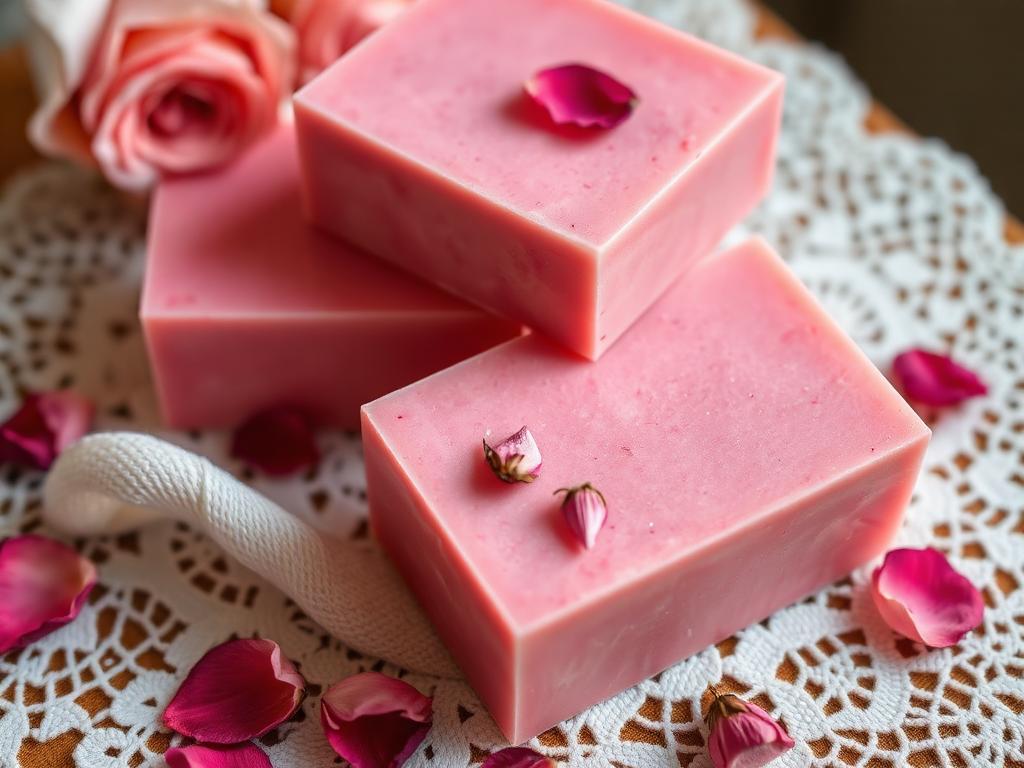
Rose clay similarly works its magic through sheer aesthetic beauty. This naturally occurring pink clay from France—the famous French rose clay, also called pink kaolin—adds a soft, feminine blush to soap without artificial dyes. The color derives from iron oxide content in the clay deposits, making it as natural as the earth from which it came.
Combining these two romantic ingredients produces soap that looks and smells like it belongs in a Jane Austen adaptation. The pale pink bars decorated with preserved rose petals evoke English cottages and afternoon tea, handwritten correspondence and unhurried mornings. This soap gets gifted more than it gets used, which I consider the highest compliment.
The technical challenge lies in preserving the rose petals' appearance. In cold process soap, organic botanicals often turn brown or discolor entirely due to the high pH environment. Rose petals are particularly vulnerable—those red and pink hues oxidize to an unappealing muddy brown within days. The solution involves placing petals only on top of the soap, where they contact less moisture, and using thoroughly dried petals rather than fresh.
I use rose absolute sparingly in the fragrance blend rather than pure rose essential oil, which costs a small fortune. Rose absolute provides authentic rose scent at a fraction of the price, extended with geranium essential oil—a floral that many people mistake for rose anyway. The combination smells genuinely rosy without requiring a second mortgage.
Safety Warnings
- Standard cold process safety gear required
- Rose clay may stain surfaces - work on protected area
- Some people have rose allergies - use caution if gifting
- Rose absolute is very concentrated - use sparingly
Tools Needed
- Safety goggles and chemical-resistant gloves
- Digital scale
- Stick blender
- Thermometer
- Silicone mold
- Small container for clay mixture
Ingredients
Step-by-Step Instructions
Prepare Clay
Mix rose clay with 1 tablespoon distilled water to form a smooth paste. Set aside.
Make Lye Solution
Carefully add lye to water. Cool to approximately 100°F.
Combine Oils
Melt coconut oil and shea butter, add olive oil. Cool to 100°F.
Blend and Color
Blend to light trace, add clay paste and essential oil. Blend to medium trace.
Pour and Decorate
Pour into mold, immediately press dried rose petals onto surface.
Cure
Insulate lightly, unmold after 48 hours. Cure 4-6 weeks.
🔧 Common Mistakes & Fixes
📦 Storage Tips
- Protect from direct sunlight to preserve petal color
- Wrap gently to avoid crushing petals
- Use within 1 year
🔗 References & Further Reading
Independent sources for the chemistry and safety information on this page. We are not affiliated with any of them.
- 1.Soap Making Safety(opens in a new tab)
Handcrafted Soap and Cosmetic Guild
Workspace, storage, and handling practices specific to lye-based soap making.
- 2.Saponification(opens in a new tab)
Wikipedia
The chemical reaction behind every bar of real soap, with reaction equations and history.
- 3.Sodium Hydroxide (CID 14798)(opens in a new tab)
PubChem, National Library of Medicine
Full chemical and hazard profile for lye, including GHS classification and handling data.
- 4.Sodium Hydroxide Poisoning(opens in a new tab)
MedlinePlus, National Institutes of Health
Symptoms and emergency first-aid steps for lye exposure. Worth reading before you open the bottle.
- 5.Personal Protective Equipment — Overview(opens in a new tab)
U.S. Occupational Safety and Health Administration
What eye, hand, and skin protection actually protects against, and how to choose it.
- 6.Poison Help(opens in a new tab)
U.S. Health Resources and Services Administration
Poison control hotline and online help. Keep this reachable while you work.
- 7.Handcrafted Soap and Cosmetic Guild(opens in a new tab)
HSCG
Industry association for handcrafted soap makers, with labeling and regulatory guidance.
- 8.Safer Chemical Ingredients List(opens in a new tab)
U.S. Environmental Protection Agency
EPA-reviewed ingredients grouped by function, useful when substituting additives.