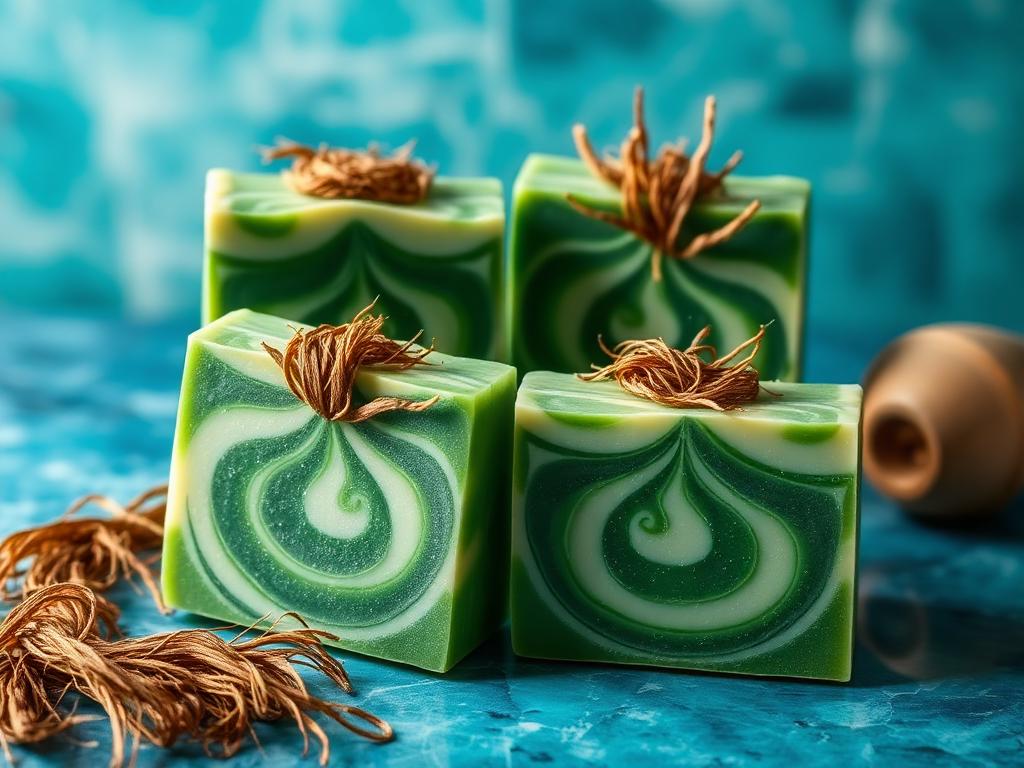
I first encountered spirulina during a health food phase that, like most phases, eventually passed. But a jar of the vivid green powder remained in my cabinet, forgotten until the day I wondered what would happen if I added it to clear soap base. The result was nothing short of magical—a deep, oceanic green that looked like captured seawater.
What I love about spirulina in soapmaking is how it connects the bar to something primal and elemental. This blue-green algae has existed for billions of years, photosynthesizing in ancient oceans long before the first fish evolved. There's poetry in using such an ancient ingredient to cleanse our modern bodies.
The first batch I made was entirely green throughout, beautiful but somewhat one-dimensional. I started experimenting with layers, creating gradient effects that mimicked the way sunlight penetrates ocean water—darker at the bottom, lighter at the top. Each bar became a tiny window into a underwater world.
Adding sea salt to the formula came from wanting more texture and mineral content. The salt crystals suspended in the clear base catch light in interesting ways, creating an effect like sunlight dancing on waves. The sensory experience of using this soap—the slight grittiness of the salt, the clean scent of eucalyptus, the visual reminder of the sea—turns a daily routine into a brief vacation.
Spirulina can be temperamental. Too much makes the soap look almost black rather than green. Too little barely shows. The sweet spot I found is about half a teaspoon per pound of base, adjusted slightly based on the specific spirulina brand. Each batch taught me something new about balancing color and clarity.
I've given this soap to friends who live far from any ocean, and they tell me using it in their morning shower helps them feel connected to something larger than their landlocked lives.
Safety Warnings
- Spirulina can stain surfaces - work carefully
- Test spirulina for freshness - rancid powder smells fishy
- Some people are sensitive to algae - patch test recommended
- Eucalyptus essential oil is strong - use sparingly
Tools Needed
- Glass measuring cups (multiple for layering)
- Silicone molds
- Small whisk
- Digital scale
- Rubbing alcohol spray
Ingredients
Step-by-Step Instructions
Prepare Spirulina Mixture
Mix spirulina powder with 1 tsp of melted base to create paste. This prevents clumping.
Melt Base in Portions
Divide base into portions for layering if desired. Melt first portion.
Create First Layer
Add most spirulina paste to first portion for darkest layer. Add salt and pour.
Layer Building
Wait until first layer is tacky. Pour next layer with less spirulina. Repeat.
Final Touch
Add eucalyptus to final layer. Top with seaweed pieces if using.
🔧 Common Mistakes & Fixes
📦 Storage Tips
- Store away from direct sunlight to preserve color
- Natural colors may fade over time - normal
- Use within 4-6 months
🔗 References & Further Reading
Independent sources for the chemistry and safety information on this page. We are not affiliated with any of them.
- 1.Glycerol (CID 753)(opens in a new tab)
PubChem, National Library of Medicine
Properties of glycerin, the humectant that makes melt & pour bases sweat in humid air.
- 2.Saponification(opens in a new tab)
Wikipedia
The chemical reaction behind every bar of real soap, with reaction equations and history.
- 3.Sodium Hydroxide (CID 14798)(opens in a new tab)
PubChem, National Library of Medicine
Full chemical and hazard profile for lye, including GHS classification and handling data.
- 4.Sodium Hydroxide Poisoning(opens in a new tab)
MedlinePlus, National Institutes of Health
Symptoms and emergency first-aid steps for lye exposure. Worth reading before you open the bottle.
- 5.Personal Protective Equipment — Overview(opens in a new tab)
U.S. Occupational Safety and Health Administration
What eye, hand, and skin protection actually protects against, and how to choose it.
- 6.Poison Help(opens in a new tab)
U.S. Health Resources and Services Administration
Poison control hotline and online help. Keep this reachable while you work.
- 7.Handcrafted Soap and Cosmetic Guild(opens in a new tab)
HSCG
Industry association for handcrafted soap makers, with labeling and regulatory guidance.
- 8.Safer Chemical Ingredients List(opens in a new tab)
U.S. Environmental Protection Agency
EPA-reviewed ingredients grouped by function, useful when substituting additives.