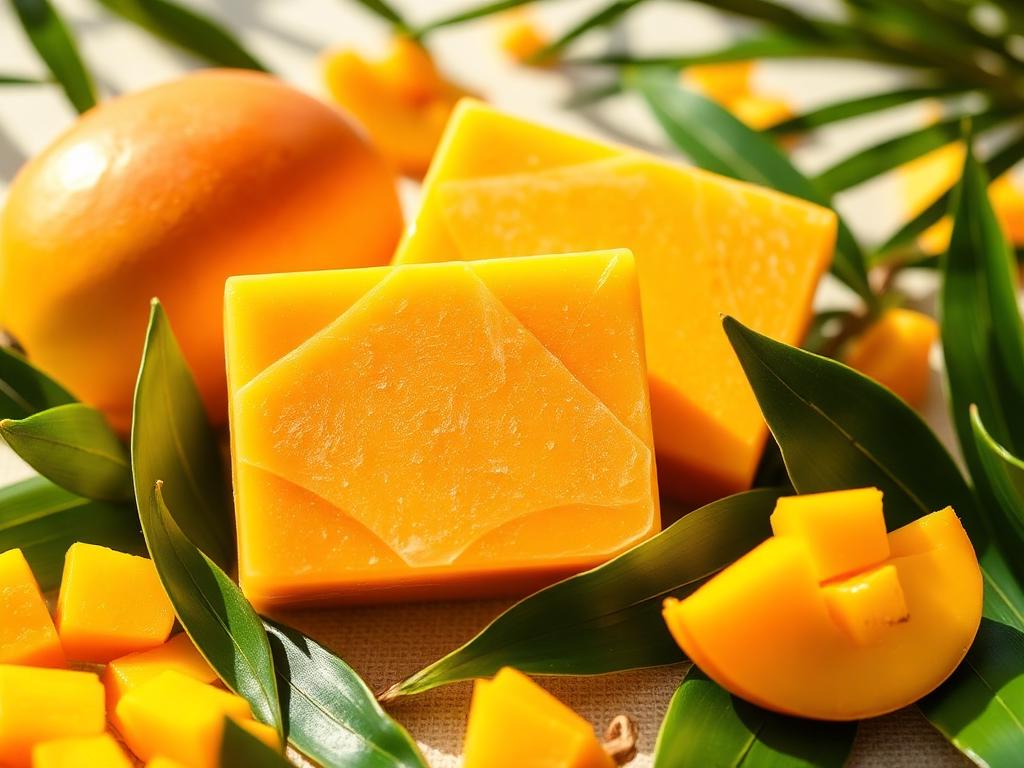
The first mango I ever tasted came from a street vendor in Southeast Asia during a college backpacking trip. She sliced it right there on the street, the juice running down her weathered hands as she handed me a piece. That burst of tropical sunshine on my tongue remains one of my most vivid flavor memories, and this soap is my attempt to capture that moment.
Mango butter as a soap base ingredient is wonderfully conditioning. Unlike coconut oil bases that can feel slightly drying, mango butter leaves skin feeling soft and moisturized. The base I use contains real mango butter, which gives the soap a subtle natural creaminess that synthetic bases can't match.
Creating the sunset-gradient effect in this soap came from watching the tropical sunsets I remembered from that long-ago trip. The sky would shift from yellow to orange to deep coral as the sun sank into the ocean. I use yellow mica at the bottom, transitioning to orange, then coral at the top—each bar becomes a tiny captured sunset.
The layering technique requires patience. Each layer must set partially before the next is added, or the colors bleed together into muddy confusion. I learned to spray each layer lightly with alcohol, wait until it was tacky but not solid, then carefully pour the next shade. The rhythm of waiting and pouring became almost hypnotic.
Mango fragrance in soap is tricky—many synthetic versions smell artificial, more like candy than fruit. I searched until I found a fragrance oil that actually smells like ripe mango: sweet but not cloying, with that slight tangy note that distinguishes real fruit from imitations.
Using this soap in winter feels like a small rebellion against grey skies. The color, the scent, the silky feel—all of it transports me back to that street vendor, that perfect mango, that moment of pure tropical joy.
Safety Warnings
- Mica can be messy - wear old clothes
- Some fragrance oils may accelerate trace in base
- Work on protected surface
- Allow each layer to set before adding next
Tools Needed
- Multiple microwave-safe containers
- Silicone molds
- Small mixing spoons
- Rubbing alcohol spray
- Kitchen scale
Ingredients
Step-by-Step Instructions
Divide Base
Cut base into three equal portions for layering.
Color Portions
Melt first portion, add yellow mica. Repeat with orange for second portion.
Add Fragrance
Divide fragrance oil between portions. Stir well.
Layer Pouring
Pour yellow layer first. Wait until tacky. Spray with alcohol, pour orange layer.
Final Layer
Pour final uncolored layer on top. Allow to set completely.
🔧 Common Mistakes & Fixes
📦 Storage Tips
- Store in cool place - mango butter can soften in heat
- Fragrance holds well up to 6 months
- Display away from direct sunlight
🔗 References & Further Reading
Independent sources for the chemistry and safety information on this page. We are not affiliated with any of them.
- 1.Glycerol (CID 753)(opens in a new tab)
PubChem, National Library of Medicine
Properties of glycerin, the humectant that makes melt & pour bases sweat in humid air.
- 2.Saponification(opens in a new tab)
Wikipedia
The chemical reaction behind every bar of real soap, with reaction equations and history.
- 3.Sodium Hydroxide (CID 14798)(opens in a new tab)
PubChem, National Library of Medicine
Full chemical and hazard profile for lye, including GHS classification and handling data.
- 4.Sodium Hydroxide Poisoning(opens in a new tab)
MedlinePlus, National Institutes of Health
Symptoms and emergency first-aid steps for lye exposure. Worth reading before you open the bottle.
- 5.Personal Protective Equipment — Overview(opens in a new tab)
U.S. Occupational Safety and Health Administration
What eye, hand, and skin protection actually protects against, and how to choose it.
- 6.Poison Help(opens in a new tab)
U.S. Health Resources and Services Administration
Poison control hotline and online help. Keep this reachable while you work.
- 7.Handcrafted Soap and Cosmetic Guild(opens in a new tab)
HSCG
Industry association for handcrafted soap makers, with labeling and regulatory guidance.
- 8.Safer Chemical Ingredients List(opens in a new tab)
U.S. Environmental Protection Agency
EPA-reviewed ingredients grouped by function, useful when substituting additives.